
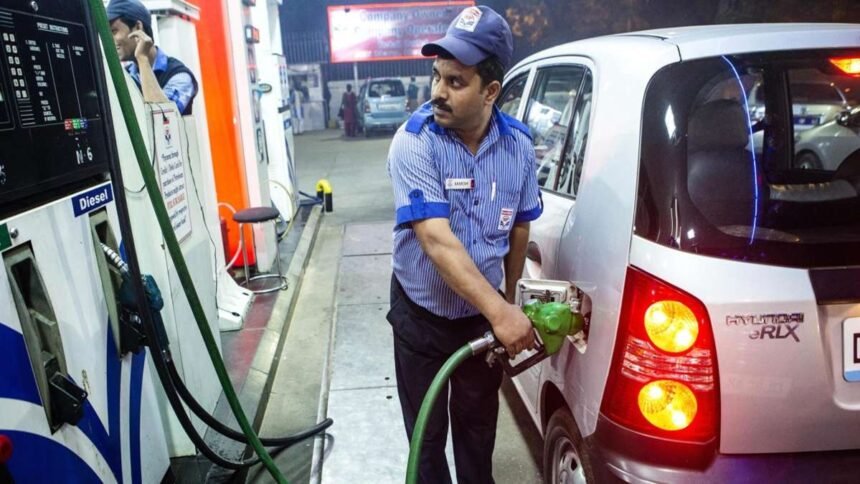
Giving great relief to the general public, the government on Friday has drastically reduced the excise duty on petrol and diesel. There has been a reduction of Rs 10 per liter on both petrol and diesel. After this, the excise duty on petrol has reduced to Rs 3 per liter, while on diesel it has been reduced to zero. The decision has been taken amid the global energy crisis, which has been deepened by the ongoing war between the United States-Israel and Iran. The situation has become more serious due to Iran blocking the Strait of Hormuz.
Bottleneck in the Strait of Hormuz
It is noteworthy that about 20% of the world’s total crude oil and gas supply passes through the Strait of Hormuz, which is between 20 to 25 million barrels per day. Before the war, India used to meet about 12 to 15 percent of its total oil requirement from the oil coming through this route. In this respect, it is an important supply route for India. According to an estimate, 40 to 50 percent of crude oil imports – or 2.2 to 2.8 million barrels per day – have historically come through this route.
Hardeep Puri called the decision a big step for the common citizen.
Union Minister Hardeep Singh Puri said in a post on social media platform This has directly affected the prices of petrol and diesel. Fuel prices have increased across the world. There has been an increase of 0%-50% in South-East Asian countries, 20% in North America, 20% in Europe and 50% in Africa.
Puri said the Modi government had two options – first, to charge Indian citizens like other countries. Second, to protect Indian citizens from international price fluctuations by impacting their financial position. Prime Minister Narendra Modi chose the second option in line with the government’s policy for four years and himself bore the financial blow for the safety of Indian citizens. The government made a major sacrifice in its tax revenue to reduce the huge losses of oil companies (about ₹24/litre on petrol and ₹30/litre on diesel). Also, in view of the increase in international prices, export tax was imposed, so that tax can be imposed on the export of petrol and diesel by any refinery to foreign countries. Puri praised Prime Minister Narendra Modi and Finance Minister Nirmala Sitharaman for this decision and called it a precise, bold and visionary step.
What difference does a decrease or increase in excise duty make?
Changes in excise duty on petrol and diesel directly impact both your pocket and the country’s economy. Excise duty, also known as excise duty, is a tax imposed on fuel by the central government.
- On increase in excise duty: Oil companies often add it to their prices, making petrol and diesel expensive.
- On reduction of excise duty: Fuel prices reduce, which provides relief to the common consumer.
This tax is the biggest revenue source for the government. This revenue is used for construction of roads, bridges and other infrastructure, defense expenditure and various welfare schemes. Its effect can also be understood from the following table:
| Factor | on increase in fees | upon reduction in duty |
|---|---|---|
| fuel price | increases | decreases |
| Dearness | increases | less likely to occur |
| government treasury | grows | decreases |
| public savings | is reduced | increases |