
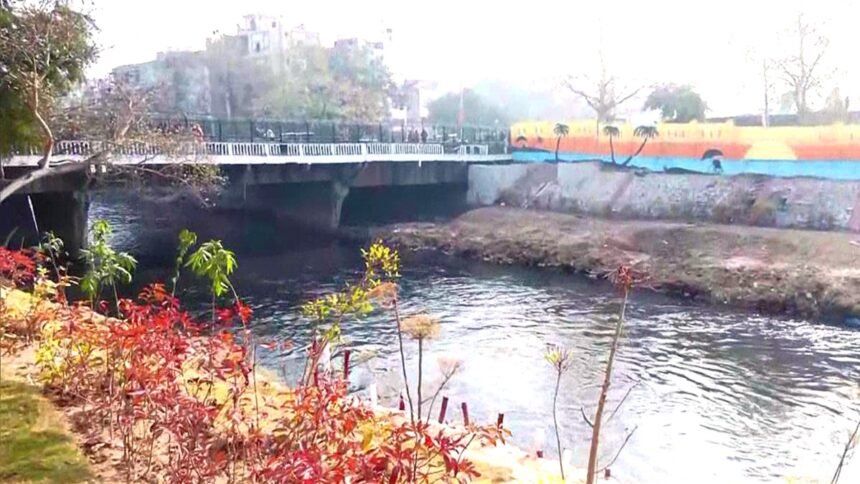
The Expenditure Finance Committee (EFC) meeting chaired by Delhi Chief Minister Rekha Gupta has approved the proposal to build a two-lane road on both sides of the Najafgarh drain. With this, the Delhi government has approved a big infrastructure project with the aim of reducing traffic pressure in the capital. To be built at a cost of about ₹453.95 crore, this corridor will directly connect Delhi to Gurugram and provide an alternative intra-city route within the city. The government says that this will reduce traffic jams on main roads, reduce travel time and reduce fuel consumption as well as pollution.
Main outline of the project
- A 5.94 km long two-lane road will be built on the left side from Jhatikara Bridge to Chhawla Bridge.
- 27.415 km road will be developed on both sides of the drain from Chhawla to Basidarapur.
- The total road length including both sides will be 54.83 km, while the total developed length will be approximately 60.77 km.
- Under the entire project, about 61 km long and 7 meter wide paved road will be prepared.
Blueprint for better connectivity
This new corridor will be connected to several major routes including Outer Ring Road, Inner Ring Road, Shivaji Marg, Pankha Road, Najafgarh Road and UER-2 (NH-9 Rohtak Road Link). Also, direct access to the airport and Dwarka Expressway will be ensured through Basidarapur, Keshopur, Vikaspuri, Kakrola and Dhulsiras.
Which areas will directly benefit?
From Dhansa to Basidarapur, this project will connect rural and urban areas. This will benefit areas like Uttam Nagar, Vikaspuri, Najafgarh, Bijwasan, Chhawla, Goyla Dairy, Dwarka, Baprola, Nilothi, Paschim Vihar, Rajouri Garden and IGI Airport. Apart from this, with better connectivity to Sector 104 and 110 of Gurugram, commuting between Delhi-Haryana will become easier. The surrounding villages connected to Dwarka Expressway will also get direct benefits from this project.
The corridor will be equipped with modern facilities
- Separate tracks for pedestrians and cyclists
- New bridge near Dwarka metro yard
- Roadside greenery and tree plantation
- New retaining walls and repair of old walls as needed
- Better security of government land
When will construction start?
Approval has already been received from the Technical Committee and Flood Control Board. Now the administrative processes will be completed. According to the government’s timeline, administrative approval has been set by March 2026, tender process completed by April 2026, construction work started by May 2026 and the target to complete the project by November 2027 has been set. This corridor will give a new direction to the transport infrastructure of the capital and will play an important role in making the traffic system in Delhi more convenient and sustainable.
Latest Business News