
The Holi of the stock market faded on Wednesday. The tension in the Middle East spoiled the colors of Holi. At 9.19 am, the BSE Sensex was seen falling 1539.33 points to the level of 78,699.52. At the same time, NSE’s Nifty was seen trading at the level of 24,397.45 with a huge fall of 468.25 points.
Major falling and rising stocks of Nifty
Major decliners in Nifty in early trade included Larsen & Toubro (L&T), InterGlobe Aviation, Shriram Finance, Adani Ports & SEZ and Bajaj Finance. At the same time, the stocks that registered gains included Bharat Electronics Limited, Infosys, Oil and Natural Gas Corporation (ONGC), Coal India and Tata Consultancy Services (TCS).
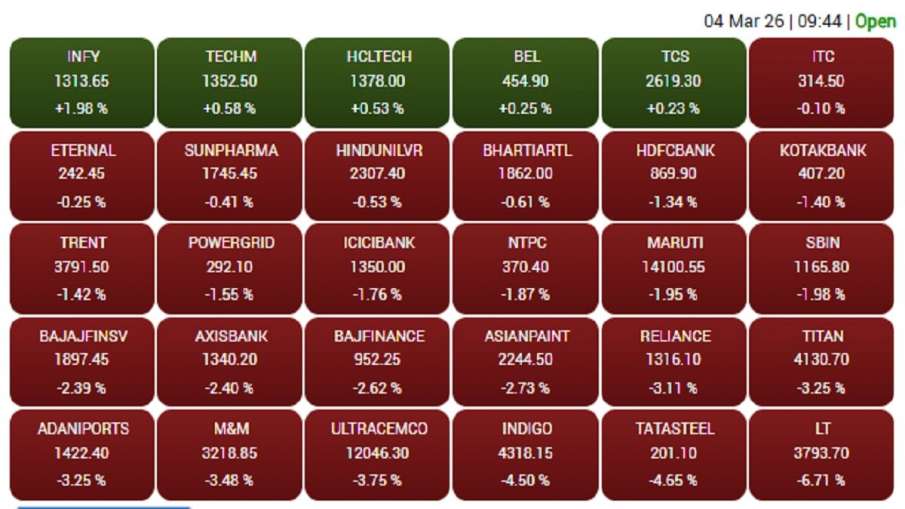
Talking about sectoral index, all the sectors are trading in the red. A decline of about 2% was recorded in media, realty, metal, PSU bank, auto and consumer durables sectors. Apart from this, a weakness of about 1.5% is also being seen in the Nifty Midcap and Smallcap indices.
What do experts say?
Market experts say that increasing tensions between Israel, the United States and Iran have affected risk appetite globally. Its effect is also visible on the Indian stock market and selling pressure may continue in the coming times.
According to experts, due to increasing geo-political tensions and security risks, insurance costs and restrictions on merchant ships passing through the Strait of Hormuz have increased. Due to this, the supply of crude oil has been affected and there has been a sharp rise in prices.
The fear of rapid rise in inflation in oil prices and pressure on the supply chain has deepened, which may have a negative impact on the equity market movement in the future.
Indian currency under heavy pressure
The Indian rupee fell to a record low of 92.17 against the US dollar. Due to increasing uncertainty in the market and liabilities of global investors, the rupee is witnessing continuous weakness. The ongoing conflict in the Middle East will increase demand for safe haven assets, strengthening the United States dollar and putting pressure on emerging market currencies. Analysts are inclined to believe that if regional tensions persist, the pressure on the rupee may continue further.
Latest Business News