
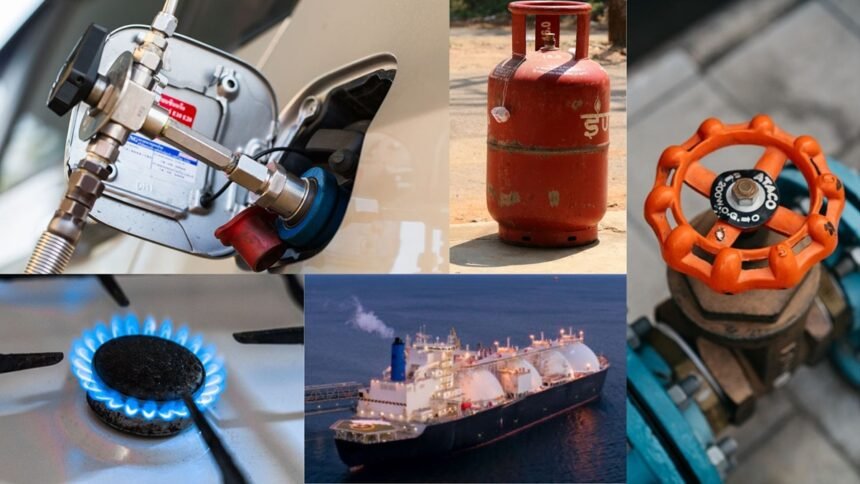
In today’s time, gas has become an integral part of our lives – be it home cooking, vehicle fuel or the energy needs of big industries. But often people consider LPG, CNG, PNG and LNG to be the same, whereas in reality these four are completely different types of gases. Their composition, storage, supply and area of use are different from each other. Understanding the exact difference between these gases not only increases your knowledge but also helps you decide which gas is safer, cheaper and better for the environment. Come, let us know in detail the difference between these gases and their actual use.
CNG
The full name of CNG is Compressed Natural Gas. It is a product of gas obtained from petroleum and is the first substance to be separated during the distillation process. CNG is odorless, tasteless and toxic. Its main component is 93.05% methane, apart from this it also contains nitrogen, carbon dioxide, propane and some amount of ethane. CNG is an environment-friendly fuel as it emits less greenhouse gases during its combustion process compared to other fuels. CNG can be easily used in modern engines. CNG is a clean and environment-friendly fuel, which is beneficial for both the vehicle and air quality.
From passenger cars to heavy duty trucks, the use of CNG is increasing rapidly, and the main reason for this is its cost-efficiency. CNG is not only cheaper than petrol and diesel, but it also prolongs the life of the engine and reduces maintenance costs. CNG not only helps in saving expenditure on fuel but also improves the maintenance of vehicles and their performance.
PNG
PNG stands for Piped Natural Gas which is a natural gas, which mainly consists of methane gas (CH4) and very small amounts of other higher hydrocarbons. It is supplied through carbon steel (CS), polyethylene (PE) and galvanized iron (GI) pipes to meet the natural gas demands of customers in diverse sectors such as domestic, commercial, non-commercial and industrial. PNG is considered completely safe because natural gas is lighter than air. If gas leaks somewhere, it rises and spreads into the surrounding air, provided there is adequate ventilation.
PNG can be used safely as cooking gas in homes and industries. Once the connection is set up, PNG is continuously supplied to our home through a gas pipeline. Whenever required, PNG can be used by turning the knob of the gas stove or geyser.
LPG
LPG i.e. Liquefied Petroleum Gas is an effective energy source, which mainly consists of propane and butane gases. It is commonly used for cooking and heating, and is also used as an alternative fuel for vehicles. LPG is cheaper than petrol and diesel. It causes less pollution than traditional fossil fuels. It is becoming popular in the automobile industry as it reduces harmful gases like carbon dioxide, nitrogen oxides and particulate matter to a great extent. LPG fueled vehicles often require less maintenance and have longer engine life. LPG is a clean, safe and economical fuel, suitable for both domestic and automotive use.
lng
LNG i.e. Liquefied Natural Gas is a clean and effective energy source, which is mainly made of methane. To achieve this, natural gas is cooled to -259.6°F, due to which it turns into liquid form. This process greatly reduces the volume of the gas and makes it easier to store and transport. LNG is used in power generation, industrial applications, as an alternative fuel for vehicles, especially heavy trucks, and marine vessels.
LNG natural gas prices generally remain low and stable compared to petrol and diesel. It produces less harmful emissions than traditional fossil fuels. LNG is a safe, clean and economical fuel, which is increasingly being used for industrial, automotive and energy production purposes.